A quoted IMRT price in Pune is meaningful only when it identifies the cancer site, treatment intent, number of fractions and every planning, imaging and review charge. By comparing those details with the treatment pathway, travel burden and centre capabilities, you can ask for an accurate estimate and choose care based on clinical fit rather than the word “advanced.”
Key takeaways
- Budget about ₹1 lakh–₹4 lakh for a conventional private IMRT course in Pune.
- Ask whether the quotation includes planning, imaging, treatment delivery and review visits.
- Compare the radiation oncologist, medical physicist, machine, quality checks and emergency support.
- Request the number of fractions, treatment intent and extra-cost items in writing.
What does IMRT radiotherapy cost in Pune, and what does the quote include?
An indicative private-sector budget for a conventional IMRT course in Pune is about ₹1 lakh–₹4 lakh. This is not a citywide tariff: a palliative course using a few fractions can cost less, while a complex definitive course, simultaneous integrated boost or longer schedule can cost more.
The price changes with the cancer site, number of fractions, planning complexity, machine time, image guidance, immobilisation device, radiation oncologist and dosimetrist fees, physics checks, and review visits. “Radiotherapy package” is too vague for comparison.
Use this process before accepting a quotation:
- Ask the centre to state whether the plan is definitive, postoperative, stereotactic or palliative, and to specify the fraction count, treatment site and prescription.
- Check whether the price includes consultation, CT simulation, immobilisation, contouring, treatment planning, patient-specific quality assurance, daily image guidance, treatment delivery and doctor reviews.
- Request a written list of exclusions. Look specifically for a second planning scan, adaptive replanning, special immobilisation, treatment-break management, anaesthesia, brachytherapy, chemotherapy, immunotherapy and follow-up imaging.
- Compare the total cost rather than the headline figure. For imrt radiotherapy near me, add weekday travel, parking, accommodation and missed work; a distant centre can cost more even with a lower package.
- Ask how machine downtime or an interruption will be handled and whether additional fractions or reviews create extra charges.
A written, centre-specific quotation is essential when comparing the IMRT radiotherapy cost in Pune or Pimpri-Chinchwad.
How does IMRT work, and when is it better than another radiation technique?
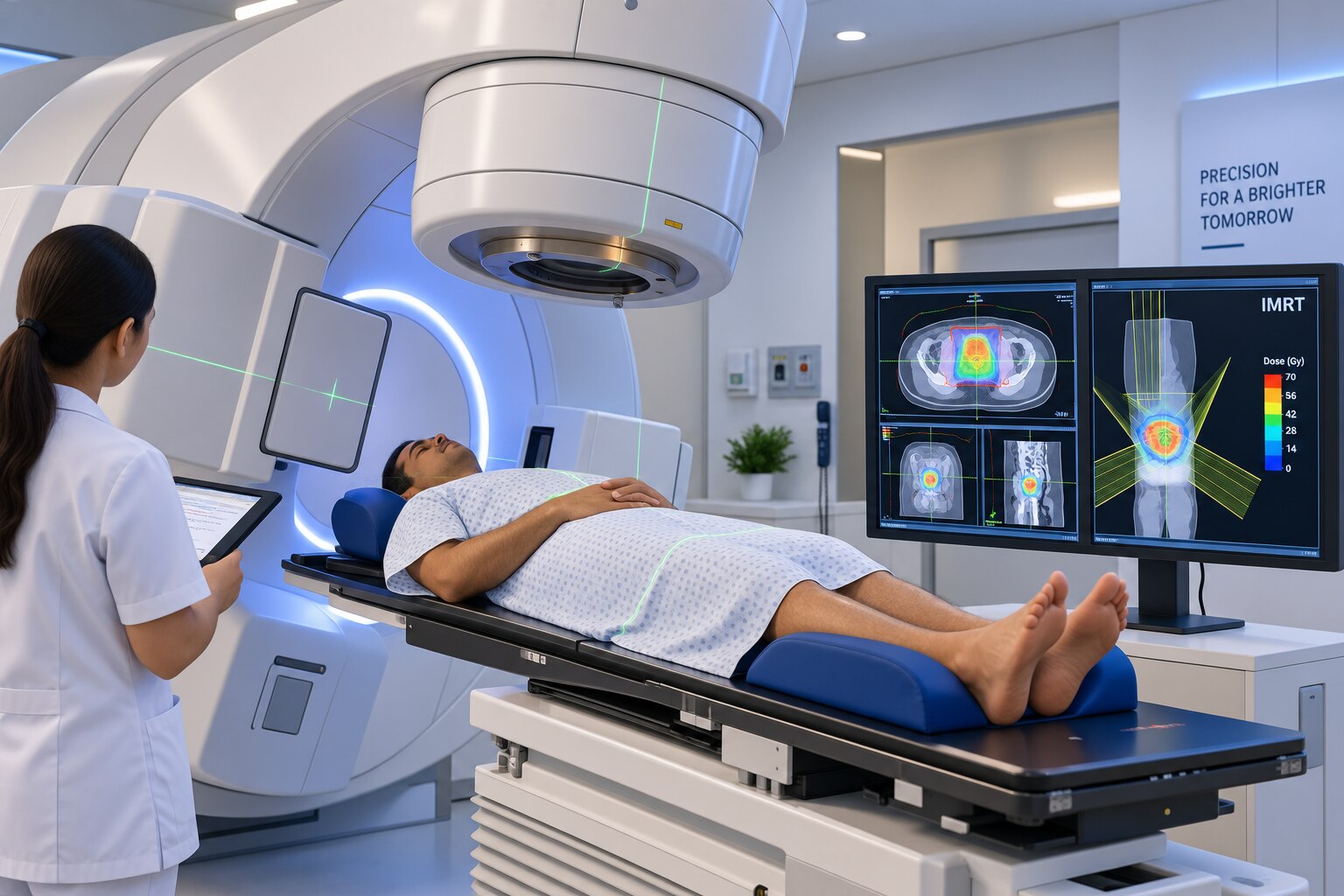
IMRT uses inverse planning rather than simply pointing beams at a tumour. You provide the target and nearby organs—such as the spinal cord, salivary glands, bladder or rectum—then planning software calculates beam angles and dose levels to meet the prescription.
A multileaf collimator continually changes each beam’s intensity, shaping dose around the target while reducing exposure to selected organs. It improves dose control, but does not guarantee fewer side effects or better survival.
It is commonly considered for:
- Head-and-neck tumours when salivary-gland or spinal-cord protection matters
- Prostate cancer when rectal and bladder doses must be limited
- Breast and pelvic cancers with nearby heart, bowel or bladder concerns
- Brain and spinal tumours where critical nerves or the spinal cord are close
- Complex targets requiring different dose levels within one treatment field
For intensity modulated radiation therapy in Pune, ask which technique the quotation names. VMAT is arc-delivery IMRT, not a separate biological treatment.
| Option | When it may fit better |
|---|---|
| 3DCRT | A simpler target where it already meets coverage and organ-dose limits |
| SBRT | A small, well-defined tumour needing a few high-dose fractions |
| Brachytherapy | A reachable tumour needing radiation placed inside or beside it |
| Surgery or systemic treatment | A tumour needing removal or drug treatment as the main therapy |
| Proton therapy | A carefully selected case where reduced exit dose justifies its limited availability |
IMRT also requires extra planning and patient-specific quality assurance, so it is not automatically the best choice.
What happens during an IMRT course, from consultation to the final fraction?
Your first consultation confirms the diagnosis, stage, treatment intent and nearby organs at risk using pathology and scans such as MRI, PET-CT or diagnostic CT. During CT simulation, you lie in the treatment position while a mould, mask or other immobilisation device helps you reproduce it; the scan becomes the planning map.
The course usually follows these steps:
- The radiation oncologist contours the tumour and organs at risk on the simulation CT, sometimes with MRI or PET-CT fusion.
- The dosimetrist creates an inverse-planned IMRT dose distribution, and the radiation oncologist approves target coverage and organ dose limits.
- Medical physicists complete patient-specific quality assurance before treatment. A plan does not proceed if its measured delivery fails the required checks.
- At each fraction, image guidance such as cone-beam CT or kV imaging verifies your position and permits corrections before radiation is delivered.
A treatment visit often takes 15 to 30 minutes, although radiation itself lasts only part of that time. Definitive courses commonly run on weekdays for about 25 to 35 fractions; postoperative, hypofractionated, stereotactic and palliative schedules use different counts. Your prescription decides the number.
The oncologist reviews you during treatment, often weekly, to assess skin or mouth changes, swallowing, fatigue, pain, nutrition and medication needs. A final fraction does not end monitoring: follow-up appointments and scans are scheduled according to the cancer and treatment intent.
When searching “imrt radiotherapy near me”, confirm that the same centre performs simulation, planning, physics checks and daily treatment.
How should you compare IMRT treatment centres in Pune and Pimpri-Chinchwad?
Compare centres by clinical process, not by the linear accelerator’s brand or by distance alone. A centre with a machine may still refer CT simulation, contouring, planning or physics checks elsewhere.
| Check | Ask the centre | Why it matters |
|---|---|---|
| Planning and expertise | Are CT simulation, immobilisation, contouring, dosimetry and planning performed in-house? Which radiation oncologist reviews your plan? | Transfers can delay planning and complicate accountability. |
| Treatment verification | Is daily image guidance used? Is patient-specific physics quality assurance documented before treatment? | Image guidance confirms positioning; QA checks that the planned dose can be delivered safely. |
| Continuity | What backup machine is available during downtime? Who decides how a missed fraction or treatment interruption is managed? | Unplanned breaks can disrupt a carefully timed course. |
| Total burden | What travel time, parking and attendant costs will daily visits add? | A cheaper quote can cost more when treatment requires many trips. |
For imrt treatment pcmc, request a written quote stating the treatment intent—definitive, postoperative, stereotactic or palliative—the fraction count, CT simulation, planning, image guidance, reviews, consumables and any excluded services. Ask specifically about adaptive replanning, repeat scans and delays caused by machine failure.
Bring biopsy and pathology reports, staging scans, operative notes, previous radiation records, medication lists and blood-test results. During a consultation with Dr Siddhesh Tryambake, use these records to ask who performs each stage and how the plan fits your tumour and nearby organs.
Searching for imrt radiotherapy near me is a useful starting point, not proof that the nearest centre is suitable.
Related service
Radiation Therapy Treatment in PCMC Advanced IMRT Radiotherapy at Phoenix Cancer Care Clinic, PCMC Phoenix Cancer Care Clinic, led by Dr. View service → |
Which questions should you ask before accepting an IMRT plan or quotation?
Do not accept a “radiotherapy package” until the plan and quotation identify the treatment purpose, dose and included services. This is essential when comparing IMRT radiotherapy cost in Pune or intensity modulated radiation therapy in Pune between centres.
| Intent | Questions to ask | Why it changes the plan and price |
|---|---|---|
| Definitive | Is treatment intended to control or cure the cancer? How many fractions and what total dose? | Usually requires comprehensive planning and a longer course |
| Postoperative | Which surgical bed and lymph-node regions are covered? | Target volumes depend on pathology and margins |
| Stereotactic | Is this SBRT or another stereotactic schedule? What image guidance is used? | Fewer, highly precise fractions require tighter checks |
| Palliative | Is the goal symptom relief rather than long-term control? | Short courses can require different planning and cost less |
Ask for the following in writing:
- The prescription: total dose, dose per fraction, fraction count, technique such as fixed-field IMRT or VMAT, and expected treatment dates.
- Target-coverage goals and organ-at-risk limits for the bladder, bowel, spinal cord, brain, salivary glands or other nearby organs.
- The side-effect trade-offs: which normal tissues receive more dose, and whether a lower-risk plan changes coverage or treatment time.
- Separate prices for consultation, CT simulation, immobilisation, contouring, planning, physics quality assurance, daily imaging, doctor reviews and consumables. Ask which imaging, medicines, repeat planning, treatment interruptions and follow-up services are excluded.
Frequently asked questions
What does IMRT radiotherapy cost in Pune?
An indicative private-sector budget for a conventional IMRT course in Pune is about ₹1 lakh–₹4 lakh. Palliative courses with fewer fractions can cost less, while complex definitive plans, simultaneous integrated boost and longer schedules can cost more.
What is included in an IMRT quotation?
Ask whether the quote includes consultation, simulation imaging, immobilisation, contouring and treatment planning, dosimetry, quality assurance, each treatment fraction, image guidance, on-treatment reviews and follow-up. Confirm which medicines, scans and additional procedures are excluded.
How does IMRT differ from other radiation techniques?
IMRT changes beam intensity across multiple radiation fields to shape the dose around the tumour while reducing exposure to nearby organs. Your radiation oncologist chooses it against techniques such as 3D conformal radiotherapy, VMAT, stereotactic radiotherapy or proton therapy based on tumour location, treatment intent and organ-sparing needs.
What happens during an IMRT treatment course?
The course usually includes consultation, imaging and immobilisation, contouring and computer planning, plan review and quality assurance, followed by repeated treatment fractions with image guidance and regular clinical reviews. The final fraction is followed by treatment completion instructions and follow-up planning.
How should I compare IMRT treatment centres in Pune and Pimpri-Chinchwad?
Compare the radiation oncologist's experience with your cancer, the treatment machine and image-guidance capability, medical physics and quality-assurance processes, appointment capacity, review arrangements, travel time and written billing. Confirm that the centre can coordinate chemotherapy, surgery or supportive care when needed.
Keywords