VMAT is not automatically the best radiation technique for every tumour. By comparing its delivery method, dose-planning benefits, trade-offs and preparation requirements, you can discuss whether it offers a meaningful advantage for your diagnosis and treatment goals.
Key takeaways
- VMAT shapes radiation while the linear accelerator rotates around you.
- Compare organ protection, treatment time and planning complexity before choosing VMAT.
- Ask how your tumour, nearby organs and previous treatments affect VMAT planning.
- Request an explanation of expected benefits, trade-offs and alternative radiation techniques.
How VMAT Delivers Radiation Differently
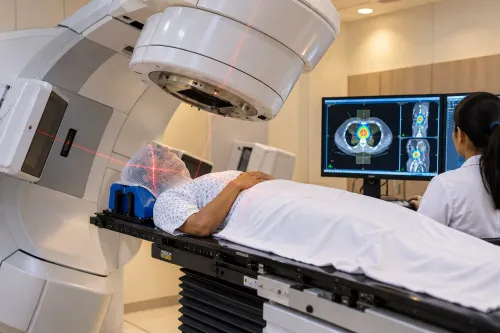
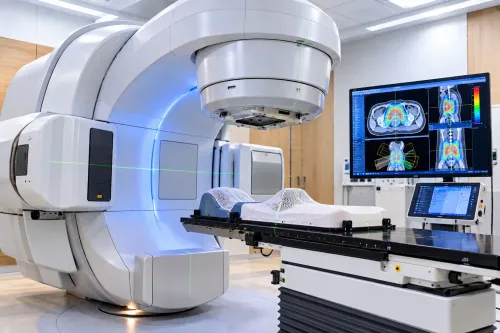
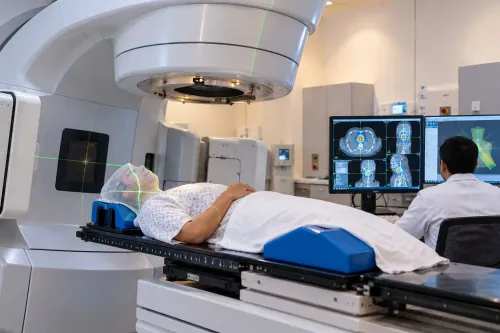
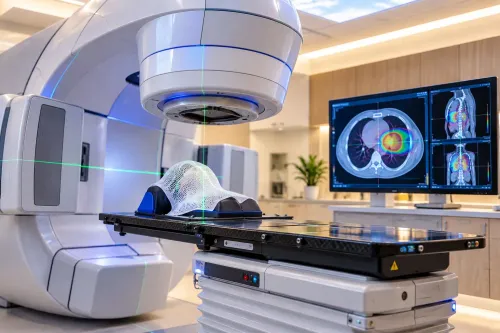
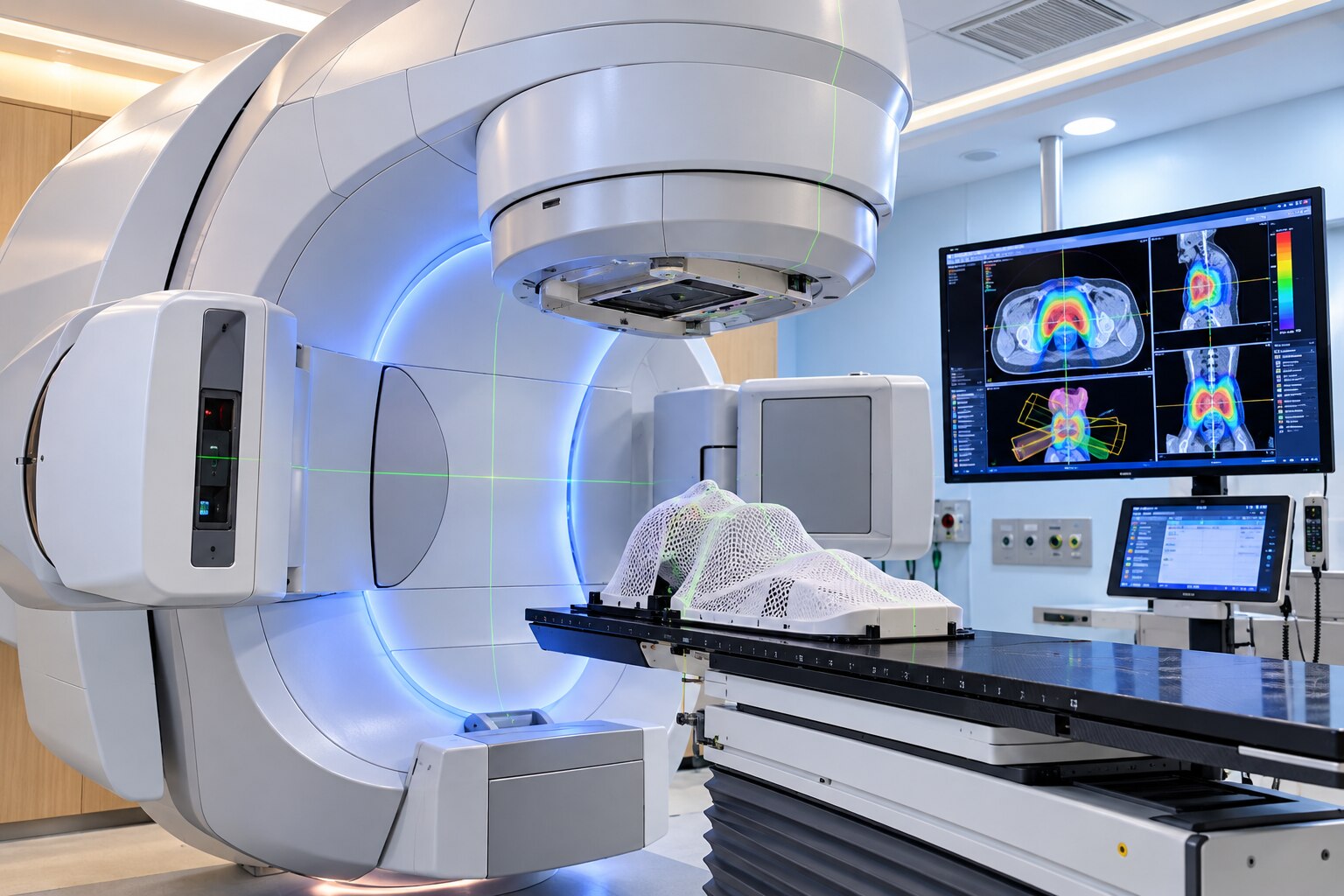
VMAT delivers photon radiation as a linear accelerator rotates around you. During each arc, the machine continuously changes the beam shape, dose rate and gantry speed while computer software optimises the planned dose distribution. The aim is to cover the tumour and limit radiation to nearby organs, not simply to give a higher dose.
| Technique | Delivery pattern | How it differs from VMAT |
|---|---|---|
| 3D conformal radiotherapy | Several fixed beams shaped to the target | Uses simpler beam arrangements and less continuous modulation |
| Fixed-field IMRT | Multiple stationary beams with changing intensity | Modulates each field, but the gantry does not rotate during delivery |
| Conventional radiotherapy | Basic fixed-field or two-dimensional arrangements | Provides less conformal shaping for complex targets |
| SBRT or SRS | Very precise treatment in a small number of fractions | Describes precision, imaging, immobilisation and dose protocols; it is not a delivery method equivalent to VMAT |
The main VMAT radiation benefits appear when a target curves around sensitive tissue or lies close to the spinal cord, bowel, kidneys, lungs, heart or salivary glands. A plan must cover the intended tumour volume first, then meet accepted dose limits for those organs.
VMAT can cause the same broad types of side effects as other external-beam treatments, including late effects months or years later.
The label advanced radiotherapy in Pune does not make VMAT automatically suitable. 3DCRT, fixed-field IMRT, brachytherapy, stereotactic treatment or proton therapy may offer a better balance for your anatomy, treatment purpose, convenience and cost. Patient-specific quality assurance must also check the planned fluence and machine delivery before treatment begins.
The Practical Benefits and Trade-Offs of VMAT
VMAT can shorten beam-on time while shaping radiation around a tumour, reducing exposure to nearby organs when the approved plan achieves that result. These are key vmat radiation benefits, but they do not make VMAT the best choice for every patient. Treatment time still depends on the site, prescription, number of arcs and linear accelerator.
| Feature | Potential benefit | Limitation |
|---|---|---|
| Dose shaping | Covers complex targets while protecting organs at risk | A highly conformal plan can still create a wider low-dose spread |
| Delivery time | Often faster than many fixed-field IMRT plans, making immobilisation easier | Faster delivery does not guarantee better tumour control |
| Planning flexibility | Supports treatment of irregular targets and difficult anatomy | Planning and contouring require time, imaging and specialist review |
| Stereotactic treatment | VMAT can deliver stereotactic plans | VMAT is not itself SBRT or radiosurgery; those require strict imaging, immobilisation and dose protocols |
The benefits of vmat radiotherapy in Pune depend on the plan, not the machine label. Ask whether CT simulation and image guidance are available, who contours the tumour and organs at risk, which dose constraints apply, and whether a second plan was compared.
Patient-specific quality assurance must check the planned fluence and machine delivery against defined tolerances before the first fraction. It confirms safe delivery; it does not prove that one centre’s plan is superior.
Three-dimensional conformal therapy, fixed-field IMRT, brachytherapy, SBRT or proton therapy may offer a better balance of control, normal-tissue exposure, convenience and cost for your case.
Which Tumours May Be Suitable for VMAT
A tumour is suitable for VMAT when its shape, location and treatment goal justify continuously modulated radiation rather than a simpler plan. A radiation oncologist reviews CT simulation, MRI or PET/CT information, the target volume, nearby organs at risk, previous radiation, tumour motion and the number of planned fractions.
| Option | What it does | When it may fit |
|---|---|---|
| VMAT | Rotates around the patient while changing beam shape, dose rate and speed | Complex targets around the spinal cord, salivary glands, bowel, bladder or other sensitive organs |
| 3DCRT | Uses shaped beams designed from the tumour’s three-dimensional outline | More regular targets with enough separation from critical organs |
| Fixed-field IMRT | Delivers modulated radiation from several stationary beam angles | Irregular targets where fixed angles produce a better dose distribution |
| SBRT | Gives a high dose in a small number of precisely image-guided fractions | Small, well-defined tumours away from structures that cannot tolerate the dose |
VMAT often suits prostate, head and neck, brain, spine, thoracic, abdominal and pelvic tumours, but the body site alone does not decide. A plan that protects the rectum better for prostate cancer, for example, may not be the best plan for another patient’s anatomy.
SBRT is not an alternative delivery machine: VMAT can deliver SBRT when the prescription and precision requirements are met. Proton therapy or brachytherapy may also be considered.
Do not choose based only on labels such as vmat treatment in pune or advanced radiotherapy in pune; compare the predicted tumour coverage, organ doses, fraction schedule, accuracy requirements and cost.
What Personalised VMAT Planning Involves
Before the first fraction, your team turns diagnostic images into a deliverable radiation plan. CT simulation records your treatment position and creates the planning dataset; MRI or PET/CT information may be added when it improves tumour definition. You are also fitted with immobilisation aids so you can reproduce that position each day.
- The radiation oncologist reviews your diagnosis, imaging, prior treatment and treatment intent.
- The tumour is contoured as the gross tumour, clinical target volume and planning target volume.
- Organs at risk are contoured so the plan can limit dose to nearby healthy tissue.
- The physicist and dosimetrist optimise the arc arrangement, beam shape, dose rate and delivery speed against prescribed dose constraints.
- The oncologist approves the plan after reviewing target coverage and organ doses; a second plan comparison can expose a better balance between them.
- Patient-specific quality assurance checks that the linear accelerator can deliver the approved plan accurately before treatment starts.
Image guidance matters because anatomy is not identical every day. Position, bladder or rectal filling, weight and tumour shape can change, and a highly conformal plan leaves less room for setup error. Before each fraction, on-treatment imaging helps the team identify shifts and apply appropriate corrections.
Ask whether these steps are included when comparing vmat treatment in pune or volumetric modulated arc therapy pimpri chinchwad. VMAT describes delivery, not a guarantee of suitability; your diagnosis and dose objectives determine whether the plan is appropriate.
Questions to Ask Before Choosing VMAT Care in Pune
A proposed VMAT plan is worth choosing only when it meets your dose goals safely, not because the machine is newer. Ask the radiation oncologist to show how the target and organs at risk were contoured on your CT simulation scan, and which dose constraints the plan must meet.
- Which imaging defines the target: planning CT alone, or CT fused with MRI or PET?
- Who reviewed the contours, and can you see the prescribed dose, target coverage and doses to organs such as the spinal cord, bowel, bladder, lungs or salivary glands?
- Was a second plan, such as fixed-field IMRT or 3DCRT, compared using the same objectives?
- What image guidance will be used before each fraction, and what correction follows a position or organ-filling mismatch?
- Has patient-specific quality assurance measured the planned fluence and machine delivery against defined tolerances before treatment starts?
- How long will each session take, and how many visits will you need?
| Option | What to compare | Question that exposes a weak choice |
|---|---|---|
| VMAT | Target coverage and organ doses | Does faster delivery preserve the same safety objectives? |
| Fixed-field IMRT | Dose distribution and treatment time | Is extra beam-on time justified by better sparing? |
| 3DCRT | Simplicity and normal-tissue exposure | Does it adequately cover this target’s shape? |
| SBRT | High dose per fraction and motion control | Is this fractionation appropriate for tumour size and location? |
For benefits of VMAT radiotherapy in Pune, compare documented plan results rather than clinic claims. Dr Siddhesh Tryambake can help you interpret whether volumetric modulated arc therapy in Pimpri-Chinchwad fits your diagnosis, prior treatment and daily-care needs.
Frequently asked questions
How does VMAT deliver radiation differently?
VMAT uses a rotating linear accelerator that continuously changes beam shape, dose rate and gantry speed during one or more arcs.
What are the practical benefits and trade-offs of VMAT?
VMAT can improve dose shaping around a tumour and protect nearby organs, but it requires detailed planning and does not suit every treatment.
Which tumours may be suitable for VMAT?
VMAT may be considered when a tumour has a complex shape or lies close to sensitive organs, including selected cancers of the head and neck, prostate, brain, spine and pelvis.
What does personalised VMAT planning involve?
Planning involves imaging, defining the tumour and organs at risk, setting dose goals, creating arcs, checking the plan and verifying patient positioning.
What should you ask before choosing VMAT care in Pune?
Ask which technique is recommended for your cancer, how nearby organs will be protected, how long planning and treatment will take, and what alternatives exist.
Keywords