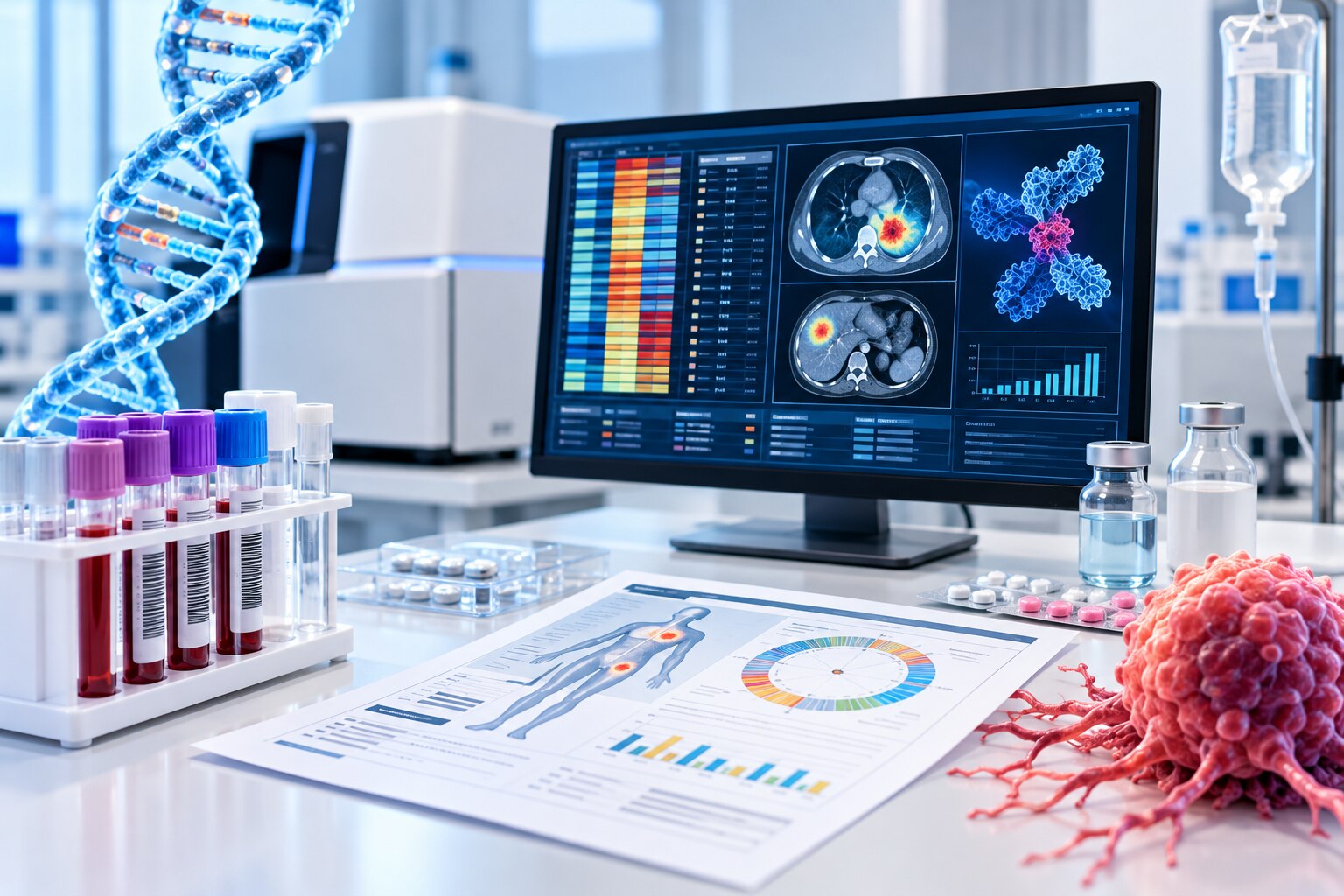
A genomic result is useful only when it is linked to a confirmed diagnosis, an adequate sample, the right assay and a treatment decision. By following each step, you can prepare the required records, understand what the laboratory tested and discuss whether a finding changes your cancer care.
Key takeaways
- Confirm cancer type and stage before ordering genomic testing.
- Choose tissue, blood, saliva or liquid biopsy based on the clinical question.
- Match hotspot panels, NGS, exome or genome testing to the decision needed.
- Ask which report findings can change treatment, prognosis or trial eligibility.
1. Confirm the diagnosis, stage and reason for testing
Sequencing is not the first step. The genomic precision oncology process in Pune begins by confirming the cancer type and stage through pathology, imaging and the oncology team’s review. Doctors then ask whether a genomic result could change treatment, clarify prognosis, identify an inherited risk or open a clinical-trial option.
1. Confirm the pathology diagnosis. The report should identify the tumour’s type, grade and relevant biomarkers. If the diagnosis is uncertain, a pathology review comes before molecular testing; testing the wrong tumour can produce an irrelevant result.
2. Establish the current stage. Review scans, biopsy findings, spread to other organs, previous treatments and the date of each treatment. A mutation that matters in metastatic disease may not change management after complete surgery for an early-stage cancer.
3. Define the clinical question. The oncologist records whether the goal is to find a targeted therapy, assess immunotherapy markers such as mismatch-repair deficiency or microsatellite instability, investigate resistance, or evaluate possible hereditary cancer risk.
4. Check whether the result would alter a decision. Consider performance status, organ function, comorbidities, drug interactions, expected toxicity, affordability and the patient’s goals. A molecular alteration can identify an option, but it does not by itself select chemotherapy, immunotherapy, radiation, surgery or supportive care.
For a complex case, pathology, molecular and medical, radiation or surgical oncology specialists can review the question together. Ask where the test is performed, what quality system covers it, what happens if the sample fails and whether the laboratory is accredited for that specific test scope.
2. Choose the right sample: tumour tissue, blood, saliva or liquid biopsy
A representative tumour tissue sample is preferred for somatic testing, which looks for acquired mutations, fusions, amplifications and other changes in cancer cells. Germline testing looks for inherited variants and uses blood or saliva; a finding can affect relatives, so it needs separate consent and genetic counselling.
| Sample | Main use | Important limitation |
|---|---|---|
| Tumour tissue | Somatic profiling from a biopsy or archived formalin-fixed, paraffin-embedded block | Low tumour percentage, necrosis, decalcification or exhausted tissue can make results unreliable |
| Blood or saliva | Germline testing for inherited cancer risk | A tumour result suggesting an inherited variant requires confirmation in blood or saliva |
| Blood liquid biopsy | Somatic circulating-tumour-DNA testing | A negative result does not rule out an alteration because some tumours shed little DNA |
If tissue is inadequate, ask the pathology laboratory whether it can test unstained slides or the remaining tissue block, and ask the oncologist whether a new biopsy is safe and likely to provide enough tumour.
A liquid biopsy can provide a treatment clue when re-biopsy is unsafe, but a negative result may need tissue confirmation if the suspected alteration would change treatment.
For molecular profiling oncology in Pune, record these details before sending a specimen:
- Specimen type, collection date and tumour percentage
- Assay used, genes or biomarkers covered, and quality-control status
- Whether the result is somatic or germline, where testing occurs, and what the laboratory does after a sample fails
Accreditation applies to a laboratory’s stated scope, not automatically to every test or genomic finding.
3. Compare hotspot panels, NGS, whole-exome and whole-genome testing
These tests differ mainly in breadth, speed, cost, and the types of genomic changes they can detect. An oncologist compares them against the cancer type, available tissue, urgency, previous results and the treatment question.
| Test | What it examines | When it may apply |
|---|---|---|
| Hotspot panel | A short list of known mutations in selected genes | When a recognised alteration could immediately guide treatment, or tissue and time are limited |
| Targeted NGS panel | Many genes, often covering mutations, copy-number changes, fusions and selected biomarkers | When several treatment targets or resistance mechanisms need assessment |
| Whole-exome sequencing | Protein-coding regions across roughly 20,000 genes | When a rare cancer, unusual response or negative panel needs broader investigation |
| Whole-genome sequencing | Coding and non-coding DNA across the entire genome | When structural changes, difficult-to-characterise disease or research-level profiling justifies maximum breadth |
A hotspot panel can miss an uncommon mutation, fusion or resistance alteration outside its targets. A broad NGS panel offers more information but also produces more uncertain findings that do not select treatment. Whole-exome and whole-genome testing require careful interpretation and are not automatically better for routine care.
Ask where the assay is performed, whether the laboratory is accredited for that specific scope, how failed samples are handled, and whether detected alterations are clinically validated. A tumour test is not a germline diagnosis; suspected inherited findings need confirmatory blood or saliva testing and genetic counselling.
4. Read the report and connect findings to treatment choices
An actionable alteration has credible evidence that a matched drug, approved biomarker-based treatment, or clinical trial could benefit this cancer. The result must also fit the tumour type, stage, previous treatments, performance status and treatment goals. “Actionable” does not mean “automatically appropriate.”
Check these details before connecting the finding to a therapy:
- Confirm whether the result is somatic, found in tumour DNA or RNA, or germline, found in inherited DNA.
- Record the specimen type, collection date, tumour percentage, assay used, genes and biomarkers covered, and quality-control status.
- Check the alteration’s classification: pathogenic or likely pathogenic findings have stronger clinical weight than variants of uncertain significance (VUS).
- Match the finding against current national or international guidelines, drug approvals and relevant clinical trials.
A VUS is not a treatment target by itself. Do not use it alone to choose a drug or test relatives; reinterpret it if the laboratory later changes its classification.
A negative result means the assay found no relevant alteration within its technical scope. It does not prove that the tumour has no driver, especially when tissue contains little tumour, DNA quality is poor, or the panel excludes the relevant gene.
An inherited pathogenic finding can affect relatives and future cancer-risk management, not only the current tumour. Discuss confirmation and genetic counselling separately from treatment selection.
A precision oncology assessment in Pune should document the interpretation date. A personalized cancer treatment assessment may need review at progression, after resistance, or when new evidence emerges.
5. Prepare for the results consultation and treatment plan in Pune
Bring one folder, not just the genomic report. Include the pathology report, scan reports and images, biopsy details, discharge summaries, a complete list of previous treatments, current medicines and supplements, allergy records, recent blood tests, and your insurance or budget questions.
- Write down your priorities: extending life, controlling symptoms, avoiding hospital visits, preserving work or family responsibilities, or pursuing a clinical trial.
- Ask which alteration is actionable now, which finding is uncertain, and whether the result changes treatment compared with standard chemotherapy, immunotherapy, radiation, surgery or supportive care.
- Ask about expected benefit, major toxicities, monitoring, drug interactions, administration schedule, total cost and whether the medicine or trial is realistically available in Pune or PCMC.
- Confirm whether the result came from tumour tissue or germline testing, the date it was interpreted, and when the laboratory or oncology team will reconsider it.
Genomic testing informs treatment planning; it does not choose treatment by itself. The team weighs the molecular finding against cancer type and stage, previous therapy, performance status, kidney and liver function, other illnesses, resistance patterns and your goals. A multidisciplinary review can involve pathology, molecular specialists, and medical, radiation and surgical oncologists.
Whether you consult Dr Siddhesh Tryambake or another oncologist, ask who will coordinate this interpretation and document the agreed next step. Reinterpretation matters if the cancer progresses, resistance develops, or a relevant medicine or clinical trial becomes available.
Related services
Procedure Guidance Genomic and Precision Oncology Genomic and Precision Oncology in PCMC Advanced Genomic & Precision Oncology at Phoenix Cancer Care Clinic, PCMC At Phoenix Cancer Care Clinic, Dr. View service → |
Dignostics Cancer Treatment Planning in PCMC – Personalized Oncology Care Comprehensive Cancer Treatment Planning at Phoenix Cancer Care Clinic, PCMC At Phoenix... View service → |
Frequently asked questions
What happens before genomic testing in precision oncology?
The oncology team confirms the cancer type and stage using pathology and imaging, then identifies the clinical reason for testing.
Which sample is used for genomic testing?
Testing can use tumour tissue, blood, saliva or a liquid biopsy. The correct choice depends on the cancer, available tissue and testing goal.
How do hotspot panels, NGS, whole-exome and whole-genome testing differ?
Hotspot panels examine selected mutations, while NGS panels cover broader gene groups. Whole-exome testing examines protein-coding regions, and whole-genome testing examines nearly all DNA.
How does a genomic report affect cancer treatment planning?
The oncology team connects report findings with targeted treatments, immunotherapy options, prognosis, inherited-risk assessment and clinical-trial eligibility.
How should you prepare for a genomic testing results consultation in Pune?
Bring pathology reports, scan results, treatment records, family cancer history and a list of medicines, then ask which findings change the proposed treatment plan.
Related services
Cancer Medicine Targeted Therapy for Cancer Treatment in PCMC Advanced Targeted Therapy at Phoenix Cancer Care Clinic, PCMC At Phoenix Cancer Care Clinic, PCMC, Dr. View service → |
Cancer Screening Genetic Counselling in PCMC – Personalized Cancer Risk Assessment & Family Guidance Expert Genetic Counselling at Phoenix Cancer Care Clinic, PCMC At... View service → |
Procedure Academy at Phoenix Cancer Care Clinic, PCMC Multidisciplinary Tumor Board for Comprehensive Cancer Care At Phoenix Cancer Care Clinic, PCMC, we believe that... View service → |
Keywords