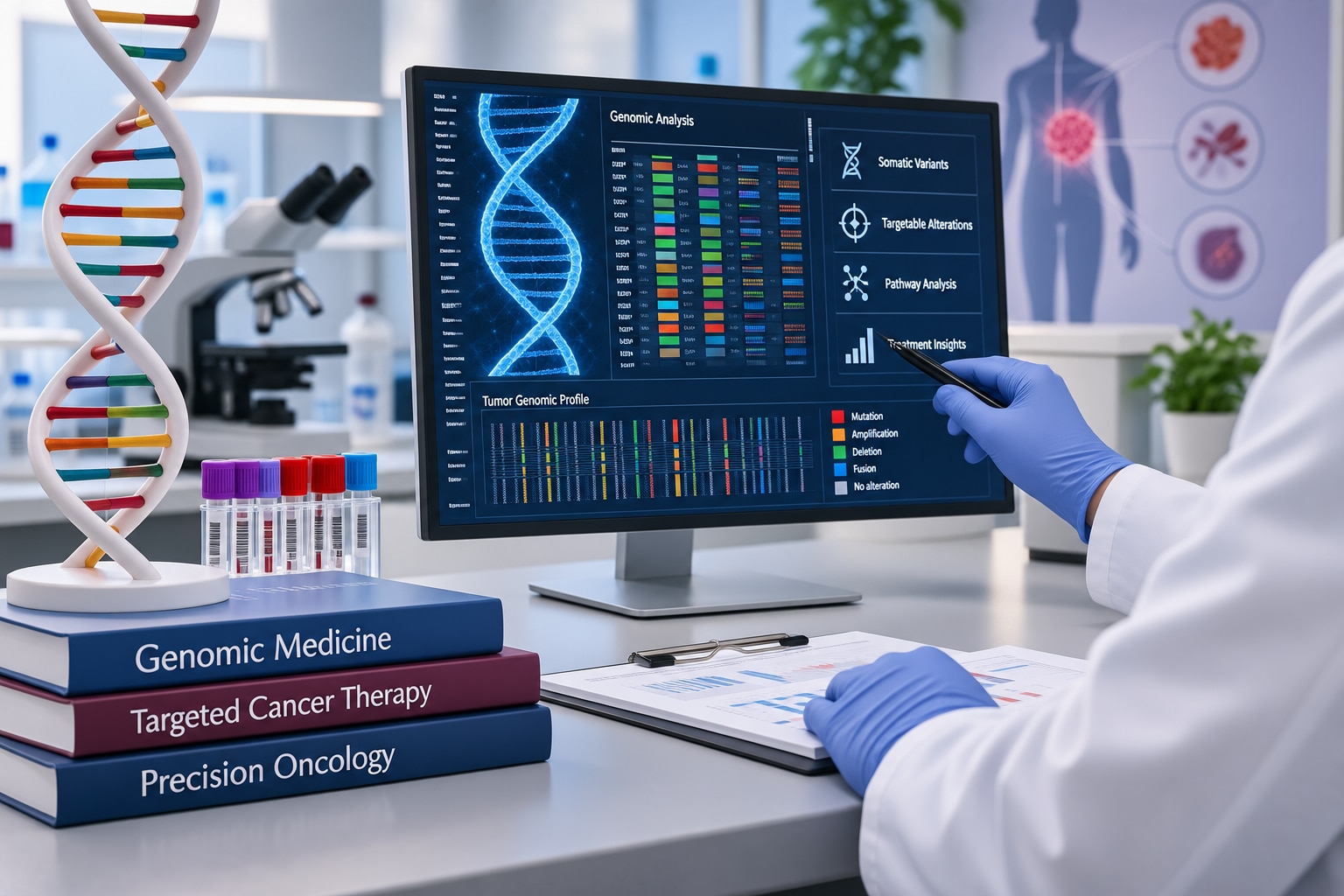
Choosing a cancer genomic test starts with a clinical question, not a search for the largest available panel. You will be able to identify the right test, prepare the correct specimen and documents, compare laboratories, and arrange an oncology-led consultation in Pune or Pimpri-Chinchwad.
Key takeaways
- Ask your oncologist before a new treatment line if a biomarker could change the plan.
- Confirm whether the laboratory needs stored tumour tissue, a fresh biopsy, or blood.
- Take pathology reports, biopsy details, scans, treatment history, and medication records.
- Book testing through your oncologist or a cancer clinic in Pune or Pimpri-Chinchwad.
Who should request genomic testing, and when?
Raise genomic testing with your treating oncologist before chemotherapy, immunotherapy or a new treatment line when a guideline-supported biomarker could change the plan. Discuss it after a new diagnosis if first-line treatment depends on a biomarker, and after progression, advanced or metastatic disease, or a rare, unusual or treatment-resistant tumour.
For genomic precision oncology in Pune, the oncologist must define the cancer type, biopsy site, previous treatment and clinical question before ordering a panel. Broad testing is poor value when no result can change treatment, trial eligibility or genetic counselling.
| Test type | What it examines | What the result means |
|---|---|---|
| Tumour or somatic profiling | Changes acquired by cancer cells, usually from biopsy tissue | It can identify treatment targets but does not prove relatives inherited the alteration |
| Germline testing | Inherited variants, usually from blood or saliva | It assesses hereditary cancer risk and may affect relatives |
| Confirmatory germline testing | A suspected inherited variant found through tumour testing | It requires genetic counselling and confirmation before family decisions |
A tumour finding that suggests a hereditary cancer syndrome needs confirmatory germline testing and genetic counselling. A negative tumour panel does not rule out inherited risk because the panel may omit relevant genes or fail to detect a germline variant.
Ask about consent, incidental findings, data storage and family implications before blood or saliva testing. Genomic testing for cancer in Pune should support a defined clinical decision, not replace an oncologist-led review of your complete record.
Which test and sample will the laboratory need?
The right test depends on the cancer, treatment decision and alteration being sought. A broad NGS panel can examine multiple genes, mutations, fusions and copy-number changes, but it does not automatically include every biomarker needed for treatment.
| Test | What it detects | Typical use |
|---|---|---|
| Next-generation sequencing panel | Multiple genes and alteration types | Broad tumour profiling |
| Single-gene test | One specified gene or variant | A focused treatment question |
| Fluorescence in situ hybridisation | Selected rearrangements or copy-number changes | Confirming a named alteration |
| Polymerase chain reaction | Defined mutations or fusions | Rapid targeted testing |
| Immunohistochemistry | Proteins such as PD-L1 or mismatch-repair proteins | Treatment selection or diagnosis |
| Microsatellite-instability testing | Unstable DNA-repeat regions | Immunotherapy assessment |
| Tumour mutational burden | Number of qualifying tumour mutations | An additional immunotherapy biomarker |
| Liquid biopsy | Circulating tumour DNA in blood | Finding actionable alterations without new tissue |
A pathology laboratory may use an archived formalin-fixed paraffin-embedded biopsy block, unstained slides, a fresh biopsy, blood or saliva. It must check tumour percentage, necrosis, DNA or RNA quality and tissue remaining for routine diagnosis. Ask whether a large panel could exhaust the block.
Testing can fail when there are too few cancer cells, decalcified bone, poor extraction or an exhausted block. Liquid biopsy is not a universal tissue replacement: low tumour shedding can produce an uninformative negative result. Before searching for molecular profiling near me, ask which sample answers the oncologist’s specific question.
What can a genomic result change in treatment?
A genomic result can identify a targeted medicine or companion diagnostic, support immunotherapy selection, match you to a clinical trial, clarify a difficult diagnosis, or help avoid a treatment unlikely to work. The result changes care only when it answers a defined clinical question.
| Evidence category | What it means | Treatment relevance |
|---|---|---|
| Approved therapy or companion diagnostic | The alteration has a regulatory indication for a specific cancer and treatment | Can support that treatment when the tumour type, prior therapy and eligibility fit |
| Clinical-trial evidence | Patient data supports a treatment, but approval may not cover this use | May support trial referral or specialist discussion |
| Preclinical finding | Evidence comes from laboratory or early research models | Does not establish clinical benefit |
| Variant of uncertain significance | The alteration’s effect is not established | Must not guide treatment selection |
An alteration alone does not guarantee benefit. Interpretation depends on the exact variant, allele or copy-number context, tumour type, previous therapies, regulatory indication, drug access and strength of evidence. Ask the oncologist to classify every proposed treatment match.
Testing is unlikely to help when tissue is insufficient, the cancer has no actionable option, the test was ordered before the oncologist reviewed the case, or the report offers no approved medicine, trial or evidence-supported match. A broad panel is useful only if its findings can change treatment, trial eligibility or genetic counselling.
Genomic testing for cancer in Pune may include tumour testing or inherited testing from blood or saliva. A negative plasma result can reflect low circulating tumour DNA and requires tissue confirmation when the clinical question remains important.
How do you arrange testing in Pune or Pimpri-Chinchwad?
Book an oncology consultation before ordering genomic testing in Pune or Pimpri-Chinchwad. The oncologist should define the cancer type, biopsy site, previous treatment, specimen and clinical question, then decide whether a hospital pathology department or independent laboratory should process it. This avoids an unselected online panel that cannot change care.
If you searched for molecular profiling near me or precision cancer treatment pimpri chinchwad, use the consultation to coordinate testing rather than booking a test alone.
Ask the clinic and laboratory:
- Is the laboratory accredited for this specific method?
- Which genes and alteration types does the panel cover?
- What is the expected turnaround time, and is a failed test charged?
- Does the report separate approved treatment evidence, clinical-trial evidence, preclinical findings and variants of uncertain significance?
- Who will request the archived block or slides, return unused material, and record the specimen’s accession or batch number?
- Who will interpret the result with your pathology, scans, treatment history and complete clinical record?
- Can consultation and specimen transfer be coordinated from Pimpri Colony, Morewadi or another nearby hospital?
| Route | Practical difference | Confirm before booking |
|---|---|---|
| Hospital pathology department | May already hold the block, slides and diagnostic records | Tissue release, testing method and report responsibility |
| Independent laboratory | May offer a broader panel or specialised assay | Accreditation, transport, failed-test policy and unused-tissue return |
Dr Siddhesh Tryambake can be one clinician to discuss this pathway with when arranging specialist oncology care.
Related service
Procedure Guidance Genomic and Precision Oncology Genomic and Precision Oncology in PCMC Advanced Genomic & Precision Oncology at Phoenix Cancer Care Clinic, PCMC At Phoenix Cancer Care Clinic, Dr. View service → |
What should you take to a cancer genomic test booking?
Bring your records to the cancer genomic test booking, even if the laboratory later requests only selected documents. For genomic precision oncology in Pune, the oncologist needs the complete context, not an isolated laboratory result.
- Take the pathology report, biopsy block or slide details if available, scan reports, treatment history, current medication list, discharge summaries and a family history of cancer.
- Ask which documents the clinic requires and whether it must retrieve the original specimen from another hospital.
- Confirm whether consent covers hereditary or incidental findings, who receives the report, and how specimens and data are stored.
- Ask whether blood or saliva testing could reveal inherited risk and whether relatives may need genetic counselling or testing.
- Confirm who will interpret the result alongside your scans, pathology and treatment history.
- Record the accession number or other specimen identifier, expected report date and the contact responsible for delays.
| Item | What to confirm | Why it matters |
|---|---|---|
| Specimen | Tissue block, slides, blood or saliva; tumour content and decalcification status | Retrieval, repeat extraction or inadequate tumour can cause failure |
| Report | Treatment-level evidence, clinical trials and confirmatory-testing needs | A rapid result is not automatically actionable |
| Timing | Delay procedure and effect on the planned treatment date | Low circulating tumour DNA or extra testing can extend turnaround time |
Frequently asked questions
Who should request genomic testing, and when?
Discuss genomic testing with your treating oncologist after diagnosis when treatment depends on a biomarker, and after progression, advanced or metastatic disease, or a rare, unusual, or treatment-resistant tumour. Raise it before chemotherapy, immunotherapy, or a new treatment line when the result could change the plan.
Which test and sample will the laboratory need?
Your oncologist should select the test based on the tumour type, treatment decision, and available tissue. The laboratory may need stored tumour tissue from a biopsy or surgery, a fresh biopsy, or a blood sample for a liquid biopsy. Confirm the required sample, pathology block or slides, tumour content, and collection instructions before booking.
What can a genomic result change in treatment?
A result can identify a targetable alteration, support or rule out a biomarker-based treatment, guide immunotherapy selection, or identify an option for a clinical trial. It can also show that a treatment is unlikely to help. Your oncologist must interpret the result alongside pathology, scans, previous treatment, and your health.
How do you arrange genomic testing in Pune or Pimpri-Chinchwad?
Start with your treating oncologist or a specialist cancer clinic. Ask which test the report must answer, which laboratory will process it, whether the laboratory accepts tissue from your hospital, and how the sample and report will be handled. Clinics providing precision oncology in Pimpri-Chinchwad or Pune can coordinate the request, sample transfer, and result review.
What should you take to a cancer genomic test booking?
Take your biopsy or surgical pathology report, available tissue-block or slide details, scan reports and images, treatment timeline, chemotherapy and immunotherapy records, current medicines, prior genomic reports, and insurance or identification documents requested by the laboratory.
Keywords