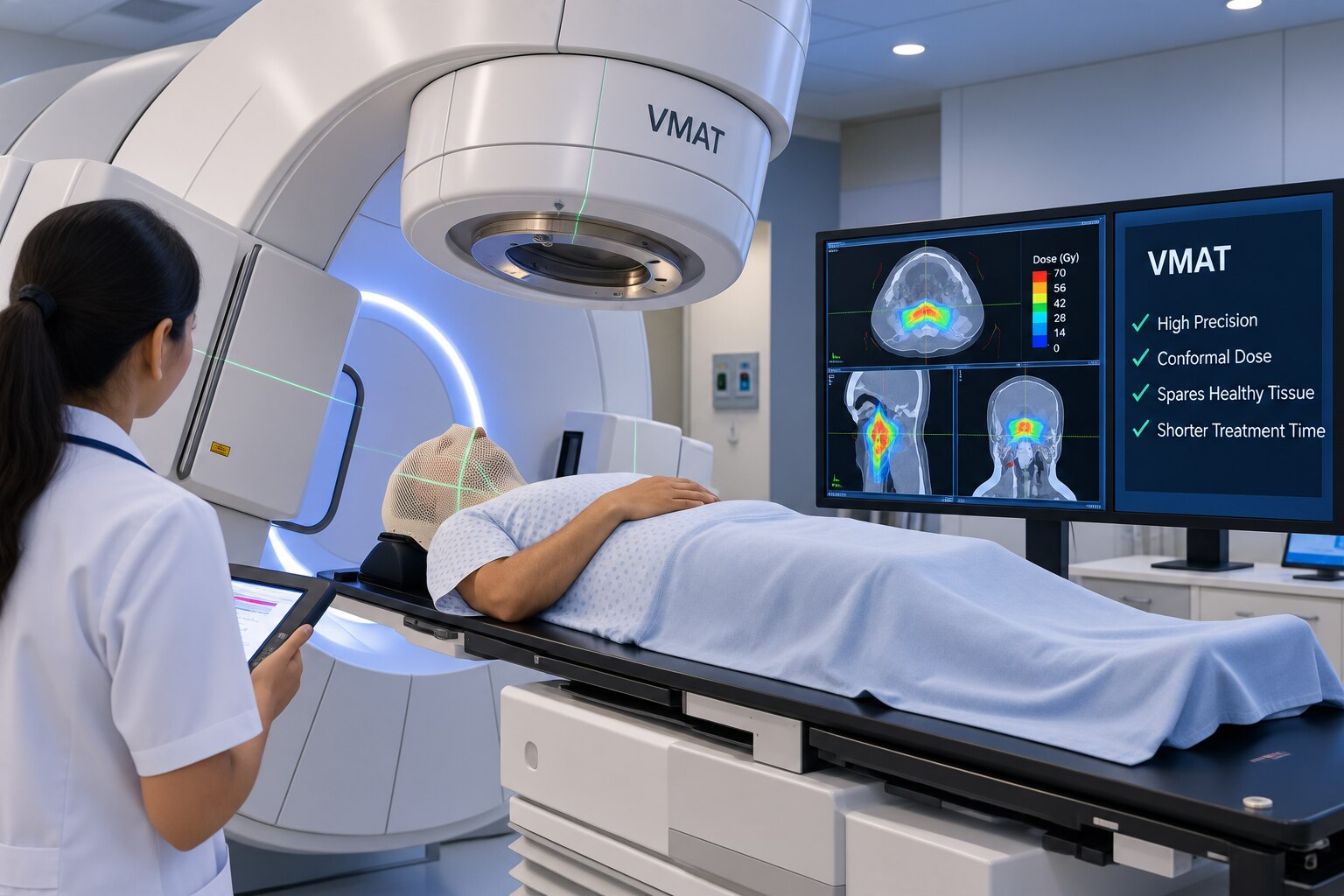
VMAT delivers radiation as a linear accelerator rotates around you, changing beam shape, dose rate and speed to match the planned target. You will be able to judge which benefits matter for your cancer, how VMAT compares with other radiotherapy techniques, and what to ask a treatment centre before starting.
Key takeaways
- VMAT shapes radiation around the tumour while limiting dose to nearby organs.
- Treatment suitability depends on tumour location, size, movement and nearby sensitive tissues.
- Compare planning accuracy, treatment time and imaging protocols—not just the VMAT label.
- Ask about quality assurance, image guidance, medical physicist checks and emergency support.
What VMAT is and how your treatment plan is built
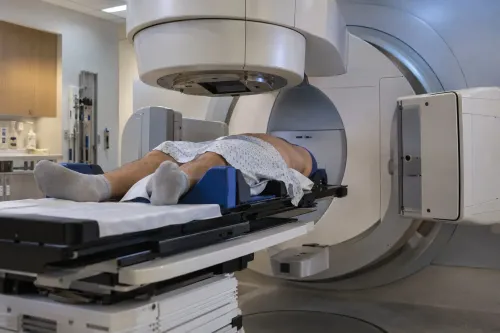
VMAT is volumetric modulated arc therapy, an advanced form of intensity-modulated external-beam radiotherapy. It is not a separate radiation source or chemotherapy. A linear accelerator rotates around you through one or more arcs while its multileaf collimator shape, dose rate and gantry speed change to form the prescribed dose.
Planning begins with a CT simulation scan in the treatment position. Immobilisation, such as a moulded mask or body support, helps you remain in the same position at every session. The team then maps the tumour and treatment target, along with organs at risk.
- The radiation oncologist defines the target and contours nearby organs at risk, including the spinal cord, bowel, bladder, rectum, salivary glands and optic apparatus.
- The team sets dose constraints, such as limiting radiation to the spinal cord while maintaining the required target dose.
- Inverse-planning software calculates beam shapes, dose rates and arc movements that meet those objectives.
- The radiation oncologist and medical physicist review target coverage, organ doses, low-dose spread and whether the plan can be delivered accurately.
During treatment, you lie still while the accelerator rotates around you. Image guidance checks your position before delivery, and patient-specific quality assurance tests confirm that the machine can reproduce the approved plan.
For volumetric modulated arc therapy in Pune, ask how the proposed plan compares with another suitable technique, not just whether the centre uses VMAT.
Which cancers can benefit from VMAT’s dose shaping
VMAT can provide a practical benefit when a tumour’s shape or position makes dose distribution difficult. Its rotating delivery can conform high dose around irregular or complex targets while reducing dose to selected nearby organs, but suitability depends on tumour location, motion, treatment intent and the organs at risk.
| Site | Potential VMAT benefit | Main suitability question |
|---|---|---|
| Prostate | Shapes dose around the gland while limiting rectum and bladder exposure | Can daily image guidance control changes in bladder or rectal filling? |
| Pelvic cancers | Covers a complex pelvic target while protecting bowel, bladder and rectum | Does the target’s size and spread justify advanced shaping? |
| Head and neck | Protects salivary glands, spinal cord and other nearby structures | Are the target and critical organs close enough to require sharper dose control? |
| Brain and spine | Helps shape dose near the brainstem, optic apparatus or spinal cord | Can immobilisation and image guidance maintain accurate positioning? |
| Lung | Conforms dose around a lesion while limiting normal lung exposure | How much does breathing move the tumour? |
| Gastrointestinal cancers | Manages curved or irregular targets near bowel, liver or kidneys | Will organ movement or filling change the daily anatomy? |
| Selected breast cancers | Limits dose to heart, lung or nearby tissue in suitable cases | Does the breast target and treatment position support this plan? |
For anyone comparing vmat radiotherapy benefits in pune or vmat cancer treatment pimpri chinchwad, compare the proposed plan with alternatives rather than the label. VMAT often has shorter beam-on time than many fixed-field IMRT plans, but that does not shorten the radiotherapy course. Positioning, immobilisation and image-guidance scans still add time in the treatment room.
How VMAT compares with 3D conformal radiotherapy, IMRT, IGRT and SBRT
These terms describe different parts of radiotherapy, not competing labels for the same treatment. 3D conformal radiotherapy shapes each beam to the tumour but changes intensity less continuously; fixed-field IMRT uses several stationary beam angles with more detailed intensity modulation; VMAT modulates the beam while the linear accelerator rotates.
| Option | What it means | When it applies |
|---|---|---|
| 3D conformal radiotherapy | Shaped beams with relatively simple dose patterns | Suitable when the target and nearby organs are straightforward to separate |
| Fixed-field IMRT | Multiple stationary beams with varied intensity | Useful for complex dose shaping without continuous rotation |
| VMAT | Modulated dose delivered during one or more rotating arcs | Useful when conformal coverage and efficient delivery are important |
| IGRT | Position-verification imaging, such as cone-beam CT | Used before or during treatment to correct daily setup differences |
| SBRT | High dose delivered in a small number of fractions | Used for selected small, well-defined targets |
IGRT and VMAT are complementary, not alternatives. VMAT describes how radiation is delivered; IGRT checks where the patient and target are positioned. Cone-beam CT adds time and a small imaging dose, so immobilisation, image registration and correction policies remain essential to safe vmat radiotherapy in PCMC.
VMAT can deliver conventional schedules, moderately hypofractionated schedules or stereotactic schedules. SBRT usually refers to the high-dose, few-fraction approach, regardless of whether VMAT or another delivery method is used. A simpler 3D technique is equally appropriate when it meets target coverage and organ-at-risk limits; the most advanced label is not automatically the best plan.
The limits, side effects and safety checks behind the VMAT label
VMAT is not a guarantee of fewer side effects, a cure for every tumour, or a shorter course of treatment. Toxicity still depends on the treatment site, dose, fractionation, target size, concurrent chemotherapy and your baseline health. A highly conformal plan can reduce dose to one organ while increasing risk elsewhere.
Examples remain site-specific: head-and-neck treatment can cause swallowing difficulty, mouth soreness or reduced saliva; pelvic treatment can affect bowel movements, rectal function or bladder function; treatment near the brain can cause local hair loss, fatigue or swelling. Organ sparing reduces risk but does not eliminate it.
Ask the treatment team to confirm:
- Whether VMAT is better than 3D conformal radiotherapy or fixed-field IMRT for your target, using target coverage and organ-at-risk doses.
- Whether the plan creates a low-dose bath, where a larger volume receives low radiation. This trade-off deserves particular attention for younger patients and people expected to live many years.
- Whether breathing motion requires four-dimensional CT, breath-hold, respiratory gating, abdominal compression or motion-encompassing margins. Ignoring motion can miss the tumour or irradiate more normal tissue.
- Whether patient-specific delivery verification confirms that the planned dose can be delivered accurately.
- Which image-guidance scan will be used, how image registration is performed, and what correction policy applies when your position differs.
Precision depends on this complete workflow, not the VMAT label alone.
How to choose a VMAT radiotherapy centre in Pune or PCMC
Choose the centre that can show a safe, patient-specific plan, not simply a machine labelled “advanced.” For VMAT radiotherapy PCMC, ask these questions before consenting:
- Is the linear accelerator commissioned for VMAT, with current machine-quality records?
- Does the centre use inverse-planning software that sets target-coverage and organ-at-risk dose objectives?
- Is cone-beam CT available before treatment, or is there an equivalent image-guidance system?
- If breathing moves the tumour, can the centre provide four-dimensional CT, breath-hold, gating or abdominal compression?
- Does every patient receive documented patient-specific quality assurance before the first fraction?
- How many fractions are prescribed, and why does that schedule suit the tumour, treatment intent and nearby organs?
- Will the radiation oncologist and medical physicist compare VMAT with IMRT or another suitable technique?
Ask to see the comparison in measurable terms:
| Option | Target coverage | Organ-at-risk dose |
|---|---|---|
| VMAT | Percentage of the prescribed dose covering the target | Dose to relevant organs such as bowel, bladder, rectum, spinal cord or salivary glands |
| IMRT or another suitable technique | Same target-coverage measure | Same organ-dose measures for a fair comparison |
A plan with a lower organ dose is not automatically better if target coverage suffers, or if it creates an unnecessary low-dose bath. Near Pimpri Colony and Morewadi, Pune, Dr Siddhesh Tryambake can connect the decision to diagnosis, treatment intent, chemotherapy or immunotherapy, and supportive care.
Choose the plan and safety workflow, not the technique’s name.
Related service
Radiation Therapy Treatment in PCMC Advanced VMAT Radiotherapy at Phoenix Cancer Care Clinic, PCMC Phoenix Cancer Care Clinic offers expert guidance and comprehensive... View service → |
Frequently asked questions
What is VMAT radiotherapy?
VMAT, or volumetric modulated arc therapy, is external-beam radiotherapy delivered by a rotating linear accelerator. The machine changes the multileaf collimator shape, dose rate and gantry speed during treatment.
Which cancers can benefit from VMAT?
VMAT can help treat tumours near sensitive organs when its dose shaping supports the prescribed plan. Your radiation oncologist decides based on the tumour’s location, size, shape and movement.
How does VMAT compare with IMRT and 3D conformal radiotherapy?
3D conformal radiotherapy uses shaped static fields, while IMRT varies beam intensity across fixed angles. VMAT delivers intensity-modulated treatment during one or more arcs, which can reduce treatment time when the plan meets dose constraints.
Is VMAT the same as SBRT or IGRT?
No. VMAT describes how radiation is delivered, while IGRT describes imaging used to position and monitor treatment. SBRT describes a high-dose, highly precise treatment approach delivered over a small number of sessions. These methods can be combined when clinically appropriate.
What safety checks should a VMAT centre perform?
Ask whether the centre performs patient-specific plan verification, daily image guidance, machine quality assurance, independent dose checks and review by a radiation oncologist and medical physicist.
Keywords